
Common skin condition
Breakouts that won’t stop?Blotchy, uneven skin?Work with a dermatologisttoward smoother, clearer skin
About 85% of teenagers get acne, and adults can too. It is linked to clogged follicles, oil, acne bacteria and inflammation. With proper treatment, the right skincare and regular habits, most people’s acne can be well controlled.
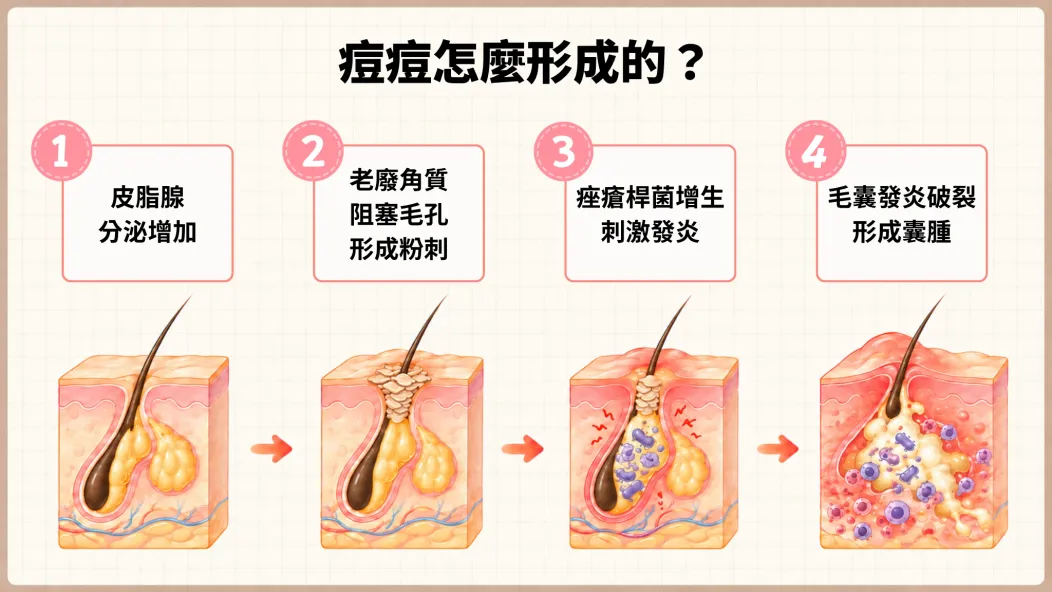
How does a spot form?
The medical name for acne is acne vulgaris. A spot generally develops in the four stages below.
- Oil glands go into overdriveHormones such as androgens make the oil glands produce more sebum, so oil builds up in the follicle. This is where a spot begins.
- Dead skin cells and oil form comedones that block the poreSkin cells pile up at the opening of the follicle, mix with the excess oil and plug the pore, forming comedones (blackheads and whiteheads).
- Acne bacteria multiply and inflammation buildsA blocked follicle is oily and low in oxygen — ideal for acne bacteria (Cutibacterium acnes, formerly Propionibacterium acnes) to multiply. This sets off an immune reaction, giving red, swollen bumps and pus spots.
- The follicle bursts, forming deep cystsAs inflammation worsens, the follicle wall breaks and its contents spill into the surrounding skin. This causes deeper inflammation, with red, painful nodules and cysts that are more likely to scar.
Risk factors for acne
Acne has different causes in different people. Any of the following can make spots more likely.
- GenesIf your parents or siblings had acne, you are usually more likely to get it too, and how severe it is can also run in families.
- Chronic inflammationExcess weight, stress and late nights lower the body’s antioxidant defenses and increase free radicals, causing low-level inflammation that makes spots more likely to become red, swollen and keep coming back.
- Hormone changesFrom puberty on, androgen levels rise in both boys and girls, driving the oil glands to make more oil. That is why acne is especially common — and can be especially severe — at this age.
- Gut–skin imbalanceRecent research shows a close link between the gut and the skin, known as the gut–skin axis. An imbalance in gut bacteria may affect inflammation throughout the body and is linked to acne.
- MedicinesSome medicines can trigger or worsen acne, such as testosterone, lithium, tuberculosis drugs, targeted cancer drugs, and long-term oral or topical steroids. If your acne clearly gets worse after starting a medicine, don’t stop it on your own — talk to your doctor first.
- Medical conditionsSome conditions raise androgen levels and bring on more acne, such as polycystic ovary syndrome, Cushing’s syndrome, congenital adrenal hyperplasia and androgen-producing tumors. If acne suddenly gets worse along with irregular periods or extra hair growth, see a doctor.
Treatment options
⚠ The actual medicines and treatments must be decided by your doctor based on the extent, location and severity of your acne and your circumstances. The information below is general education, not personal medical advice.
In Taiwan, acne medicines are either prescription-only or available from a pharmacist. For mild acne in a small area, you can ask a pharmacist about over-the-counter options (such as topical tretinoin or benzoyl peroxide). For long-lasting, severe or widespread acne, see a dermatologist for prescription treatment, such as oral isotretinoin or oral or topical antibiotics.
- Comedones
- Bumps / pus spots
- Nodules / cysts
- Dark marks
- Hormone-related
Tap a category to see its treatments
It is best to combine two or more topical treatments that work in different ways. This works better and lowers the risk of antibiotic resistance.
| Treatment | Helps with | How it works | Cautions and tips |
|---|---|---|---|
| Topical retinoidsAdapalene, tretinoin, etc. · First line Aklief Epiduo Differin, etc. |
| Clear comedones, calm inflammation and fade dark marks. Once acne is under control, they can be continued to help stop it coming back. | Caution
Tips
|
| Benzoyl peroxide (BPO)First line |
| Kills acne bacteria, gently loosens comedones, and releases oxygen radicals and benzoic acid that calm inflammation. Acne bacteria have not been found to become resistant to it. | Caution
Tips
|
| Topical antibioticsClindamycin, fusidic acid |
| Stop acne bacteria growing and calm inflammation. Best combined with another topical treatment to reduce resistance. | Caution
Tips
|
| Salicylic acidSalicylic acid 0.5–2% · Supportive |
| A topical comedone-loosening ingredient, regulated in Taiwan as a special-purpose cosmetic. | Tips
|
| Azelaic acidSupportive |
| Loosens comedones, fights bacteria and calms inflammation. Gentler than retinoids, and also fades dark marks left by spots. | Caution
Tips
|
⚠ Isotretinoin can cause serious birth defects. Strict contraception and regular pregnancy tests are required from one month before treatment until one month after stopping. Oral antibiotic courses are generally kept under 3–4 months and should not be used on their own.
| Treatment | Helps with | How it works | Cautions and tips |
|---|---|---|---|
| Doxycycline Tetracycline MinocyclineTetracycline antibiotics Minocycline is second line |
| Reduce the number of acne bacteria, block a bacterial enzyme (lipase), and reduce the white blood cells and inflammatory substances that drive inflammation. | Caution
Tips
|
| ErythromycinMacrolide antibiotic · Second line |
| Reduce the number of acne bacteria, block a bacterial enzyme (lipase), and reduce the white blood cells and inflammatory substances that drive inflammation. | Caution
Tips
|
| IsotretinoinOral retinoid |
| Shrinks oil glands and reduces oil, lowers acne bacteria, stops follicles clogging, and calms inflammation. | Caution
Tips
|
| Combined contraceptive pillEstrogen + progestin · For some women |
| Reduces androgen production and effects, lowering oil production. Works for both non-inflamed and inflamed acne. | Caution
Tips
|
| SpironolactoneAnti-androgen |
| Reduces testosterone production, blocks androgens from binding to skin receptors, and inhibits 5-alpha reductase. | Caution
Tips
|
| Treatment | Helps with | How it works | Cautions and tips |
|---|---|---|---|
| Steroid injections into spotsLow-strength triamcinolone · Supportive |
| Injected directly into inflamed bumps or nodules to quickly reduce inflammation and pain. | Caution
Tips
|
Lasers are not covered by the Taiwanese Dermatological Association consensus; the information below comes from device information and patient education articles. Long-term data on these devices is still building, so whether they suit you, and how many sessions you need, is for your doctor to judge based on your acne and circumstances.
| Treatment | Helps with | How it works | Cautions and tips |
|---|---|---|---|
| Blue laserCAPRI |
| Heat from a 1450 nm laser shrinks oil glands and reduces oil, while 450 nm blue light helps suppress acne bacteria, reducing inflammation. | Caution
Tips
|
| 1726 nm laserAccure AviClear |
| The 1726 nm wavelength is absorbed by sebum, heating and shrinking the oil glands to reduce oil, which improves the follicle environment and inflammation. | Caution
Tips
|
⚠ Co-trimoxazole (common brand names include Septrin and Baktar) has caused serious reactions such as Stevens–Johnson syndrome, severe liver failure and bone marrow suppression, so the consensus advises against using it for acne.
Newer medicines such as clascoterone (a topical anti-androgen) and sarecycline (a newer tetracycline antibiotic) are not yet licensed in Taiwan.
Choosing treatment by severity
This table summarizes the Taiwanese Dermatological Association consensus. First line and second line do not mean you must go in that order; you and your doctor will decide based on your situation.
| Severity | First line | Second line |
|---|---|---|
| Almost clear |
|
|
| Mild |
Avoid using a topical antibiotic on its own for a long time. |
|
| Moderate |
|
|
| Severe |
|
|
- These recommendations are for typical acne. Widespread nodulocystic acne and acne conglobata have different causes, look different and are more severe; they are outside this table and need separate assessment by a doctor.
- Within each line, the order does not reflect preference — no option is better than another. You and your doctor will choose based on your situation.
- If acne has already caused significant scarring, is affecting your daily life or wellbeing, keeps coming back after stopping treatment, comes with very oily skin, or you want more active treatment, isotretinoin may be considered first after a full discussion of costs and risks with your doctor.
- For widespread bumps or nodules, when inflammation and pain need to settle quickly, or when there is a risk of scarring, steroid injections into the spots can be added alongside topical or oral treatment.
Key principles
Beyond medicines, these ideas make a difference to how well treatment works and whether acne comes back.
- Treat the right targetDepending on the type of acne: reduce oil, reduce comedones, reduce inflammation, and prevent scarring.
- Don’t waitA spot takes about three months to go from comedone to gone (or to a scar), so starting proper treatment early helps most.
- More is not betterPiling on products or using high strengths can cause redness, peeling or even damage. Topical treatments usually take 4–8 weeks to work, so don’t keep switching because you see no change in the first few weeks.
- Topicals first; antibiotics never aloneBPO and topical retinoids are the first choice. Oral antibiotic courses are generally kept under 3–4 months and are not used on their own, to avoid resistance.
- Don’t stop as soon as it clearsOnce acne is under control, a topical retinoid can be continued as maintenance to keep comedones and breakouts from coming back.
- Daily habits matter tooCleanse gently and don’t over-wash, use sunscreen, keep regular hours and get enough sleep, and don’t squeeze spots — this reduces inflammation and scarring.
- Decide together with your doctorYour treatment plan should fit the extent, location and severity of your acne, as well as cost, your preferences and possible risks.
Frequently asked questions
- Taiwanese Dermatological Association: Clinical consensus on acne treatment (consensus meeting, March 2024)
- Taiwan Food and Drug Administration: So many acne medicines — how do you use them? Topical and oral treatments explained (Drug and Food Safety Weekly, issue 1083; in Chinese)
- National Taiwan University Hospital e-newsletter: Laser advances in acne treatment — long-lasting oil control without medication (by Dr. Chen, June 2026; in Chinese)
- Jih MH, et al. The 1450-nm diode laser for facial inflammatory acne vulgaris: dose-response and 12-month follow-up study. J Am Acad Dermatol. 2006
- NOWnews (Health & Medicine Network): report on blue laser treatment for acne (April 2023; in Chinese)
About the imagesThe illustrations of people and the diagrams on this page are for illustration only and are not images of real patients.