Pattern hair loss · Men
Is it all down to male hormones?Starting treatment early makes a real difference.
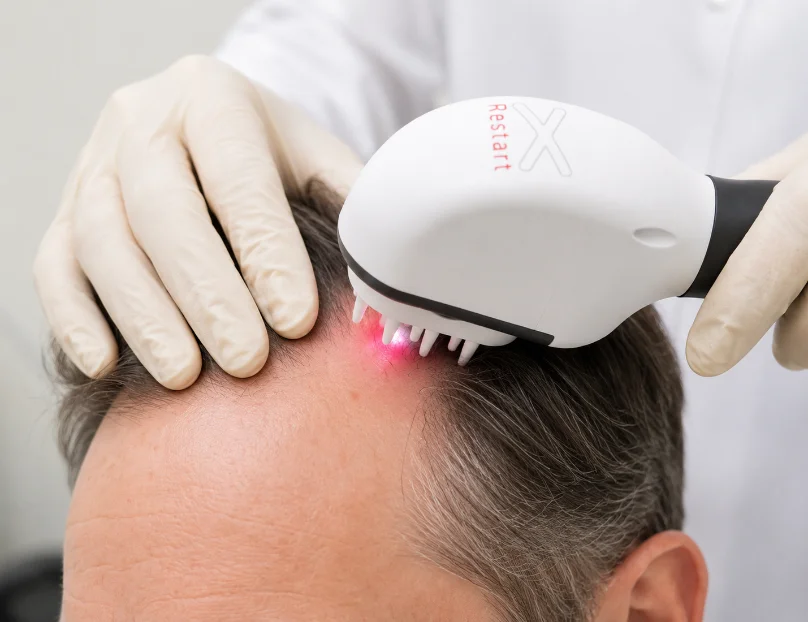
Male pattern hair loss is linked to genetics and male hormones. Getting assessed early and combining treatments tends to work better than relying on one alone — so a hair transplant doesn’t have to be your only option.
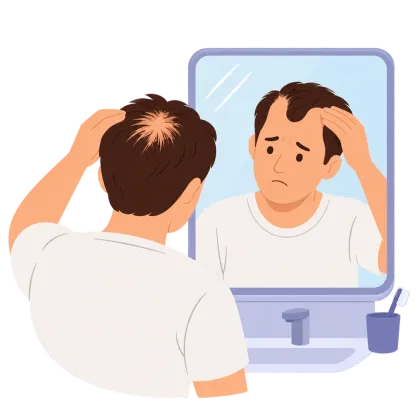
What causes it?
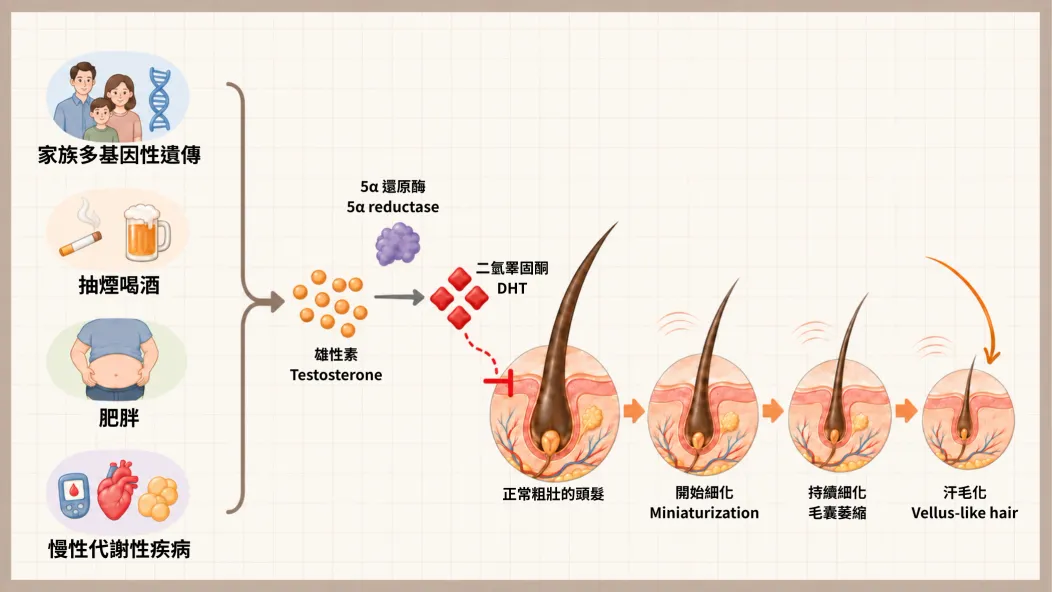
In the hair follicle, the enzyme 5-alpha reductase turns testosterone into dihydrotestosterone (DHT). When DHT binds to androgen receptors, follicles that are genetically sensitive gradually shrink — a process called miniaturization. The growth phase gets shorter, hairs become finer and softer, and eventually the follicle stops producing visible hair. This is strongly inherited and involves many genes.
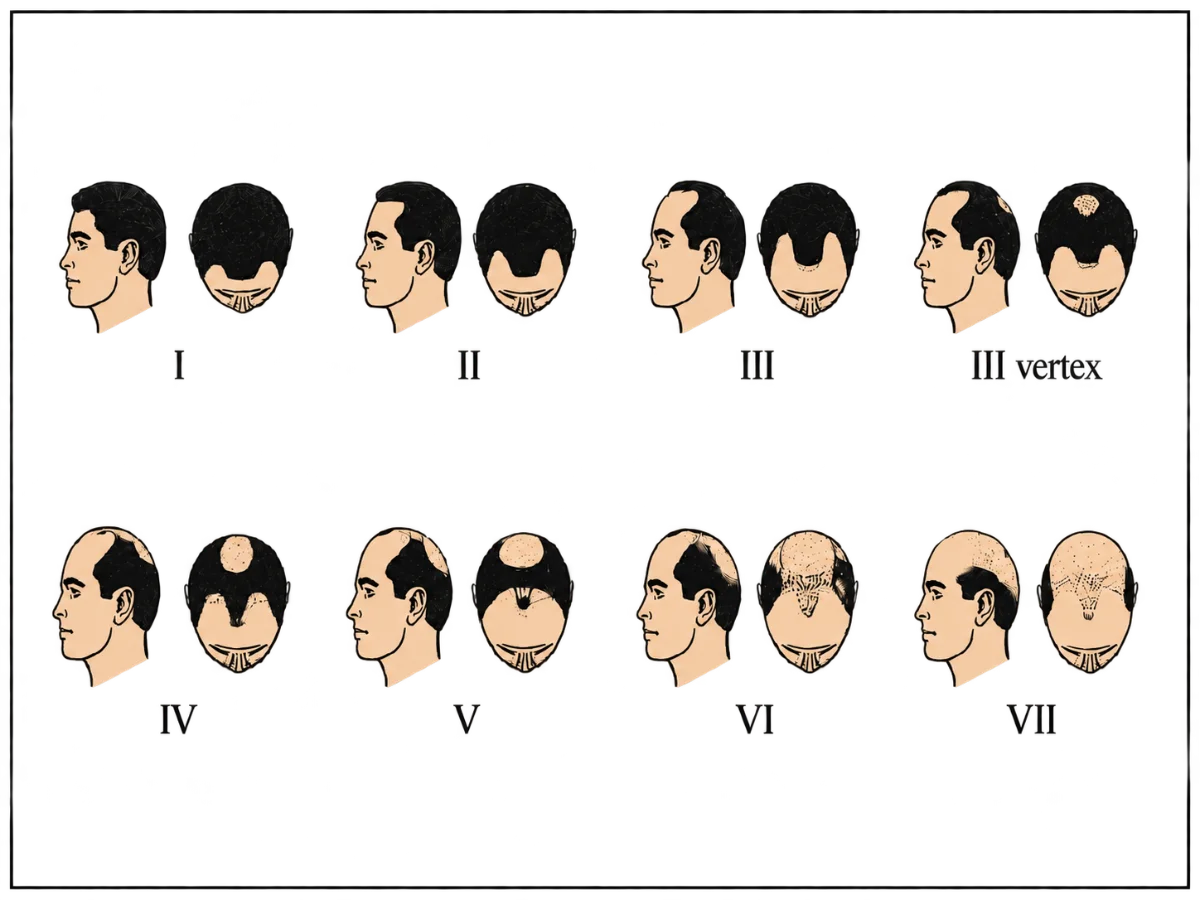
How it looks and progresses: the Hamilton–Norwood scale
Tap a stage to read more
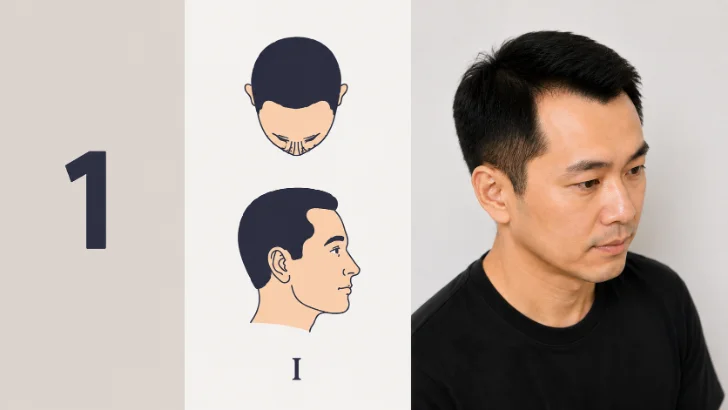
Stage I
Normal hairline with no obvious hair loss; used as the baseline for comparison.
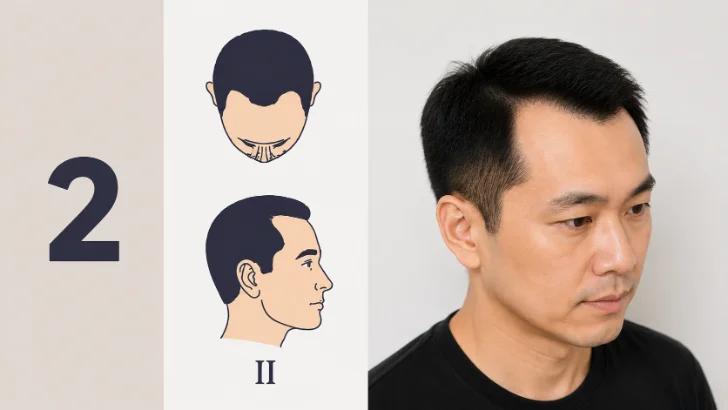
Stage II
The hairline starts to recede slightly at both temples, forming symmetrical triangular notches.
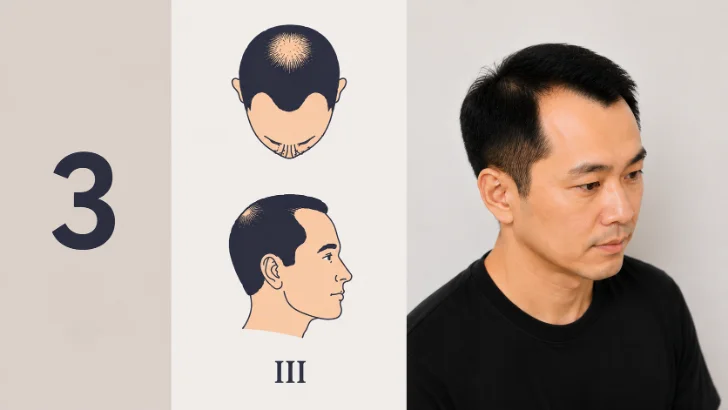
Stage III
The front hairline has clearly receded. This is the earliest stage at which pattern hair loss can be diagnosed; some men mainly thin at the crown instead (III vertex).
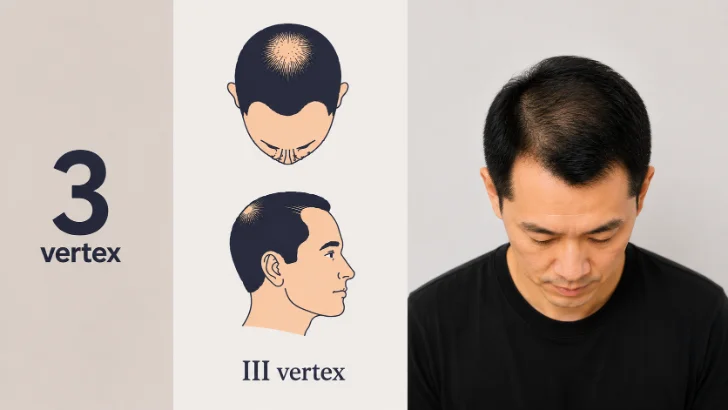
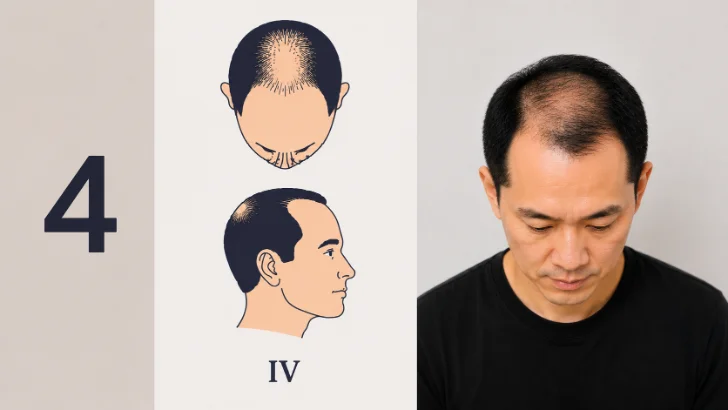
Stage IV
The receding front and thinning crown both grow larger, still separated by a band of hair.
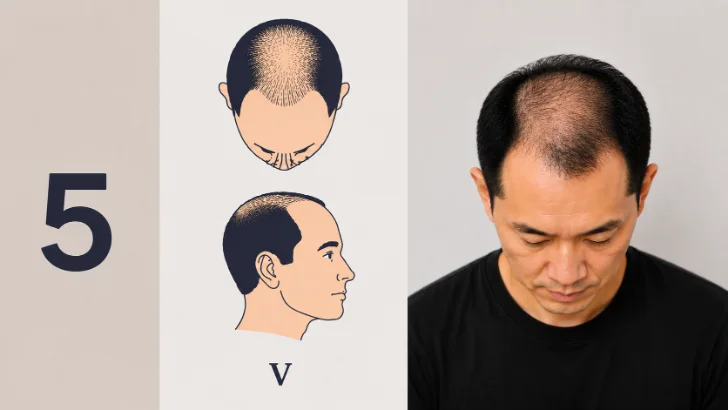
Stage V
The front and crown areas grow and move closer together; the band between them narrows.
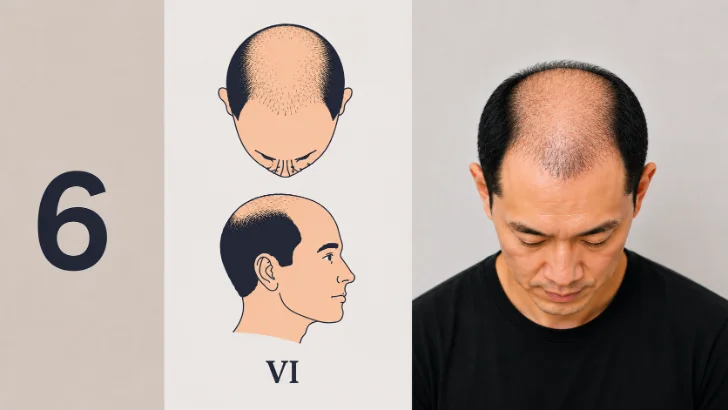
Stage VI
The front and crown areas join up and the band between them disappears.
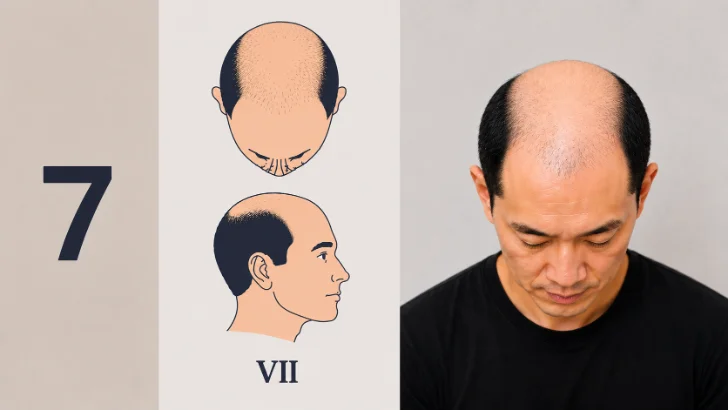
Stage VII
The most advanced stage: only a narrow horseshoe of hair remains around the back and sides.
What doctors see under the dermatoscope
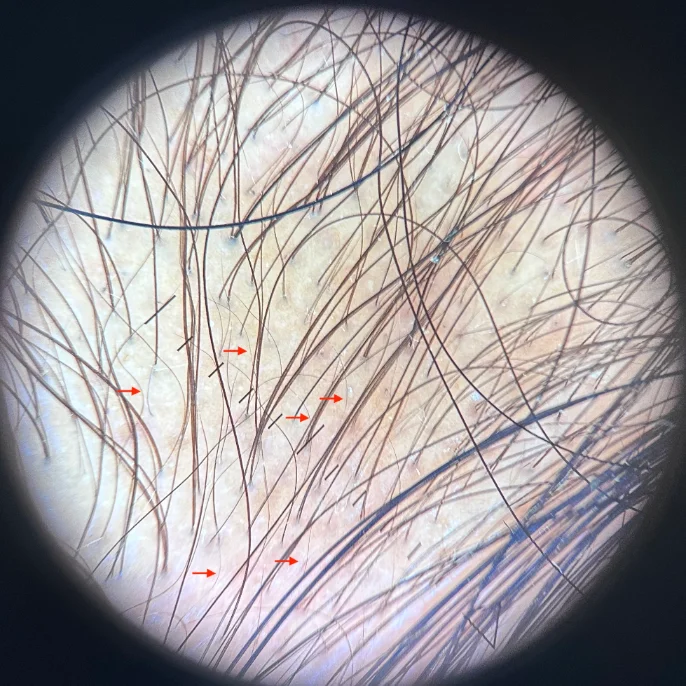
- More than 20% variation in hair thickness within the same area; hairs become finer and softer, like vellus hairs (red arrows)
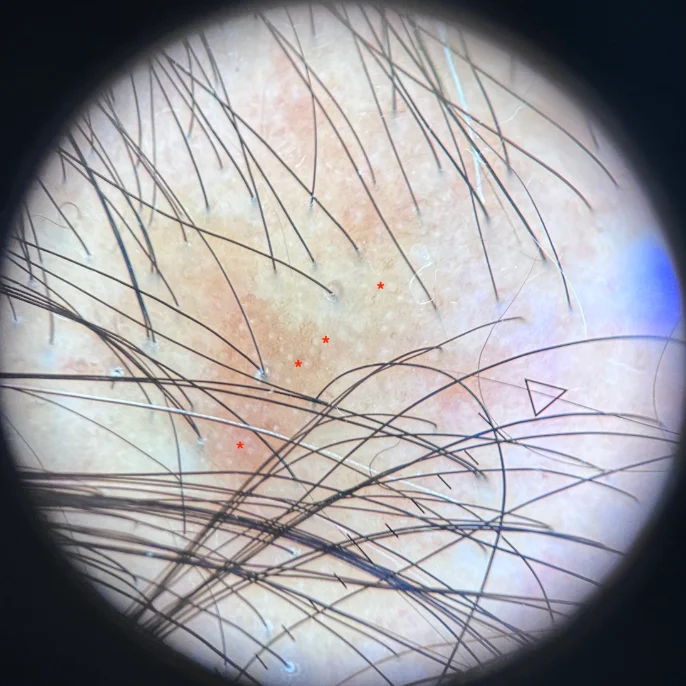
- Yellow dots: empty follicle openings (*)
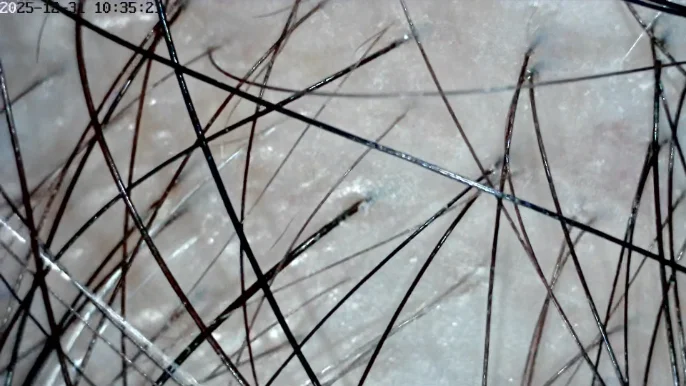
- More follicle units with only a single hair (fewer hairs per unit)
- Follicle density clearly lower at the front and crown than at the back of the head
Comparing treatments
⚠ Results and costs vary between clinics, with the doctor’s technique and from person to person. The chart below is for general education only and is not a promise of any result or price. Your actual treatment plan and costs will be based on an in-person assessment by your doctor.
A | High-level evidence: effectiveness confirmed by a meta-analysis of randomized controlled trials (RCTs).
B+ | Moderately high evidence: supported by a meta-analysis of non-randomized comparative studies (cohort or case-control), but not yet by a meta-analysis of RCTs alone.
B | Moderate evidence: supported by at least one RCT, but no meta-analysis meeting grade A yet.
C | Early clinical evidence: supported by non-randomized studies, cohort or case-control studies, but no RCT yet.
D | Limited clinical evidence: mainly case series or uncontrolled clinical studies.
E | Preclinical evidence: laboratory, cell or animal studies only, with no evidence in people yet.
* These grades describe the level of research evidence. They do not show how large the effect is, how safe a treatment is, whether regulators have approved it, or what is right for any individual patient.
The star rating (★1–5) is a rough guide to how strong the effect usually is in clinical practice. Results vary from person to person.
Tap a category to see its treatments and comparison chart
Vertical axis: cost tier ($ to $$$$$, higher is more expensive) · Horizontal axis: effect (further right is stronger) · Tap an item for details
Treatment
Oral finasteride (1 mg)
Estimated self-pay cost: $
Evidence grade
Grade AEffect
Side effects
- Sexual side effects (lower libido, erectile dysfunction) in about 1–2% of men, usually reversible
- Mood changes in a small number of people
- Breast enlargement in men (rare)
Good to know
- Must be taken continuously; the benefit gradually wears off after stopping
- Women who are pregnant or trying to conceive must not handle the tablets, especially broken or crushed ones
What it looks like
Treatment
Oral dutasteride (0.5 mg)
Estimated self-pay cost: $$
Evidence grade
Grade AEffect
Side effects
- Similar to finasteride, with slightly more sexual side effects
- Long half-life, so it takes longer to leave the body after stopping
Good to know
- Blocks both type 1 and type 2 5-alpha reductase, so it acts more broadly
- Women who are pregnant or trying to conceive must not handle it
What it looks like
Treatment
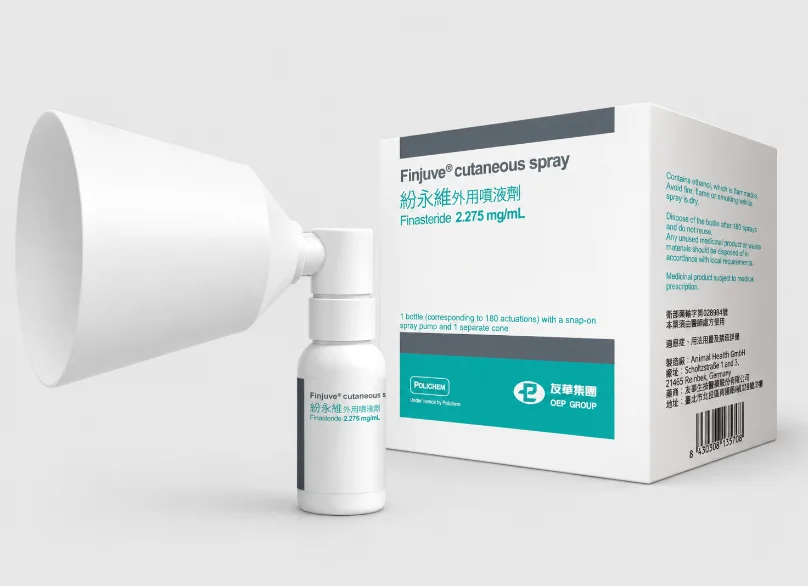
Topical finasteride
Estimated self-pay cost: $$
Evidence grade
Grade AEffect
Side effects
- Local scalp irritation, dryness or itch (uncommon)
- Fewer whole-body side effects than the tablet
Good to know
- An option for people who cannot tolerate side effects from the tablet
- Applied to the scalp every day; keep it away from the mouth
What it looks like
Treatment
Topical alfatradiol (an estradiol derivative)
Estimated self-pay cost: $
Evidence grade
Grade CEffect
Side effects
- Local scalp irritation (uncommon)
Good to know
- Works by reducing 5-alpha reductase activity in the scalp
- Lower level of evidence; how often it is used varies by country
What it looks like
Vertical axis: cost tier ($ to $$$$$, higher is more expensive) · Horizontal axis: effect (further right is stronger) · Tap an item for details
Treatment
Oral minoxidil
Estimated self-pay cost: $
Evidence grade
Grade BEffect
Side effects
- Extra hair growth on the face and limbs
- Dizziness or low blood pressure on standing up
- Swelling of the lower legs
- Palpitations (uncommon)
Good to know
- Prescribed only after your doctor checks your heart and blood pressure
- The dose is far lower than when it is used for high blood pressure
What it looks like
Treatment
Topical minoxidil (2% / 5%)
Estimated self-pay cost: $
Evidence grade
Grade AEffect
Side effects
- More shedding at first (resting hairs falling out), usually settling within 2–8 weeks
- Dry, itchy or flaky scalp
- Contact dermatitis (uncommon)
Good to know
- Needs to be used every day; the benefit gradually fades if you stop
- The 5% strength usually works better than 2%, but is more likely to irritate
What it looks like
Vertical axis: cost tier ($ to $$$$$, higher is more expensive) · Horizontal axis: effect (further right is stronger) · Tap an item for details
Treatment
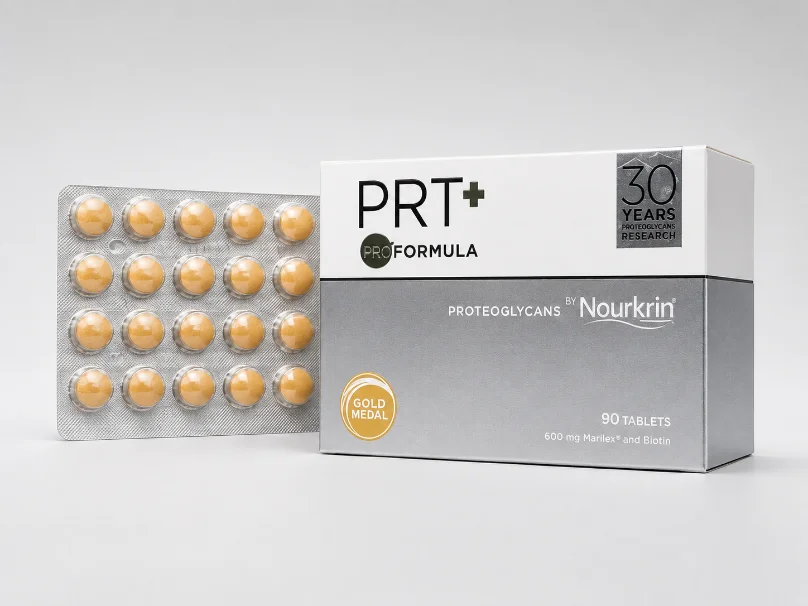
Nutritional supplement (洛克靈, sold in Taiwan)
Estimated self-pay cost: $$
Evidence grade
Grade CEffect
Side effects
- Stomach upset (uncommon)
Good to know
- An add-on, not a replacement for medical treatment
- Contains vitamins, trace minerals and plant extracts; the evidence is limited
What it looks like
Treatment
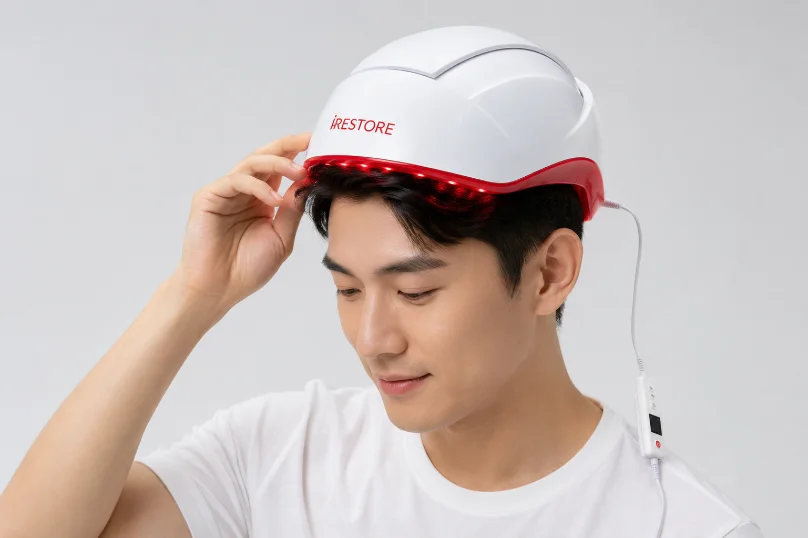
Hair-growth cap (low-level red / near-infrared light)
Estimated self-pay cost: $$
Evidence grade
Grade B+Effect
Side effects
- A warm feeling on the scalp (uncommon)
- Limited long-term safety data
Good to know
- Uses low-level red or near-infrared light (LED / LLLT) to stimulate the follicles
- Worn at home; needs regular use (several times a week) to work
What it looks like
Treatment
Hair-growth laser (Er:YAG)
Estimated self-pay cost: $$
Evidence grade
Grade BEffect
Side effects
- Mild stinging or redness where treated
- Brief scalp sensitivity afterwards
Good to know
- A gentle Er:YAG laser treatment of the scalp that boosts local blood flow and growth factors
- Done in the clinic by a doctor or trained staff, as a course of sessions
What it looks like
Treatment
PRP (platelet-rich plasma) injections
Estimated self-pay cost: $$$
Evidence grade
Grade AEffect
Side effects
- Pain, swelling or bruising at the injection sites
- Infection (rare)
Good to know
- Made by spinning down a sample of your own blood; usually a course of 3–4 sessions
- How long the effect lasts varies; top-up sessions are often needed
Treatment
Exosome scalp treatment
Estimated self-pay cost: $$$
Evidence grade
Grade BEffect
Side effects
- Mild irritation where it is injected or applied
Good to know
- A newer treatment; evidence from large, long-term studies is still building
- Often combined with microneedling or another way of delivering it into the skin
Vertical axis: cost tier ($ to $$$$$, higher is more expensive) · Horizontal axis: effect (further right is stronger) · Tap an item for details
Treatment
AMT (autologous micro-tissue transplant)
Estimated self-pay cost: $$$
Evidence grade
Grade BEffect
Side effects
- Mild pain or swelling where the tissue is taken
- Infection (rare)
Good to know
- Your own follicle tissue is processed and injected into thinning areas; this is not a conventional hair transplant
- Suited as an add-on treatment for early, diffuse thinning
Treatment
Hair transplant surgery (FUE / FUT)
Estimated self-pay cost: $$$$$
Evidence grade
Grade BEffect
Side effects
- Swelling and scabbing after surgery
- Temporary shedding after surgery (“shock loss”)
- How many grafts survive depends on technique
- FUT also leaves a linear scar at the back of the head and temporary numbness
Good to know
- FUE (follicular unit extraction): follicles are taken out one by one. Small wounds, quick recovery and no linear scar, but fewer grafts per session
- FUT (strip surgery): a strip of scalp is removed and divided into grafts. More grafts per session, but it leaves a linear scar that needs hair to cover it
- Your doctor will advise which technique suits you based on the area of hair loss and the donor area
Frequently asked questions
About the imagesSome photographs are AI-generated illustrations, not images of real patients, so no patient’s privacy is involved.
Oral finasteride (1 mg)
Common brands (tap to see what each looks like)
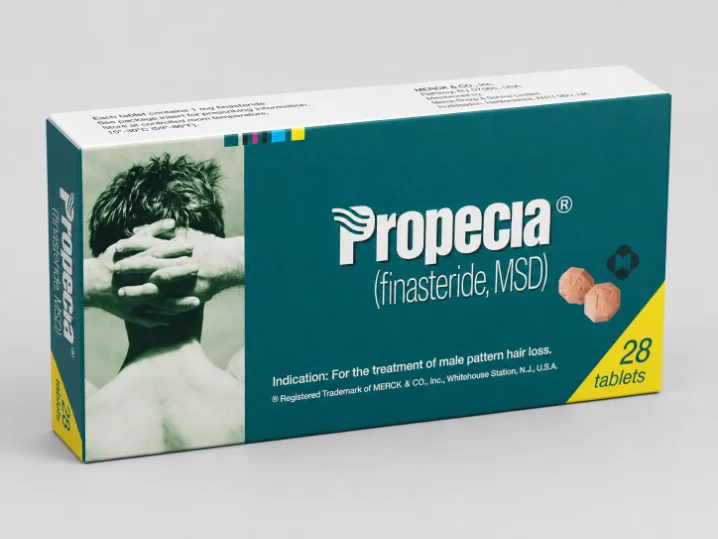
Propecia
Light orange, hexagonal film-coated tablet
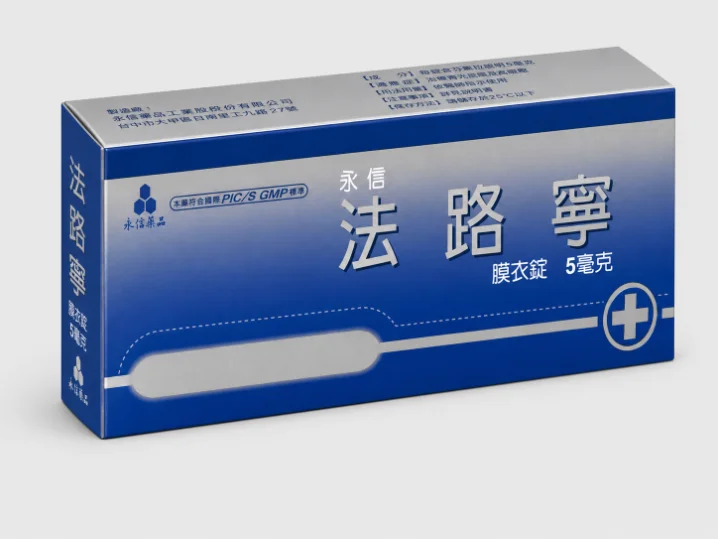
法路寧 (Taiwan generic)
Pale yellow, round film-coated tablet
Off-label use (not an approved indication for this medicine). Please discuss it fully with your doctor first.
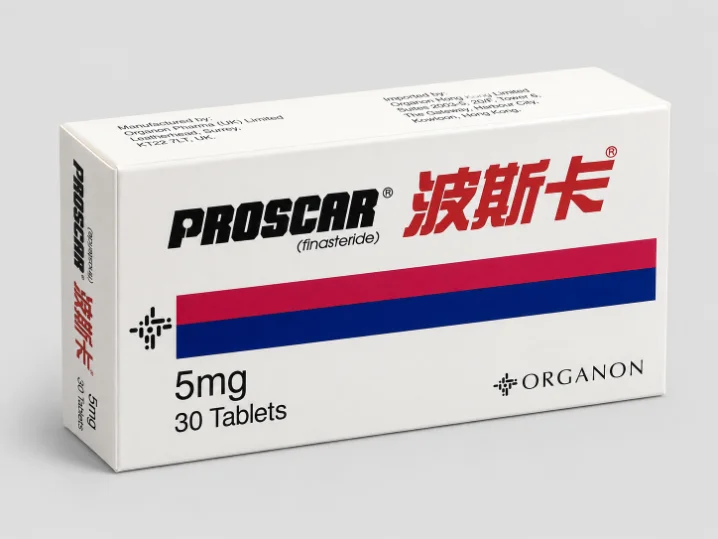
Proscar
White, round tablet
Off-label use (not an approved indication for this medicine). Please discuss it fully with your doctor first.
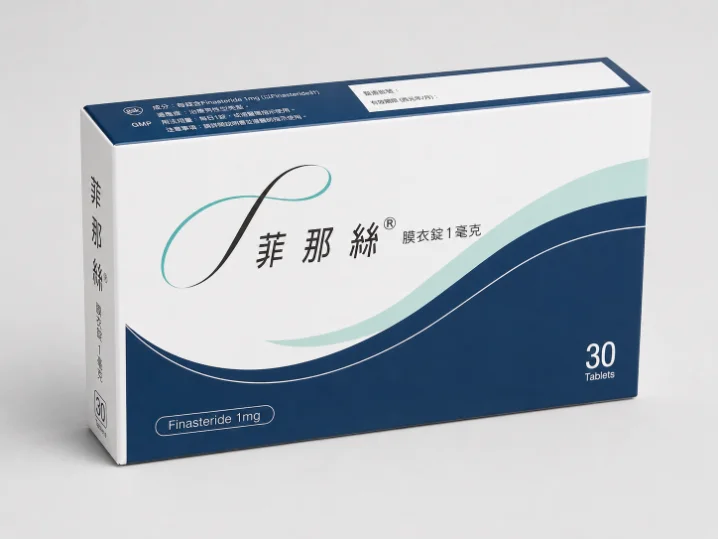
菲那斯 (Taiwan generic)
Light orange, round tablet
Off-label use (not an approved indication for this medicine). Please discuss it fully with your doctor first.
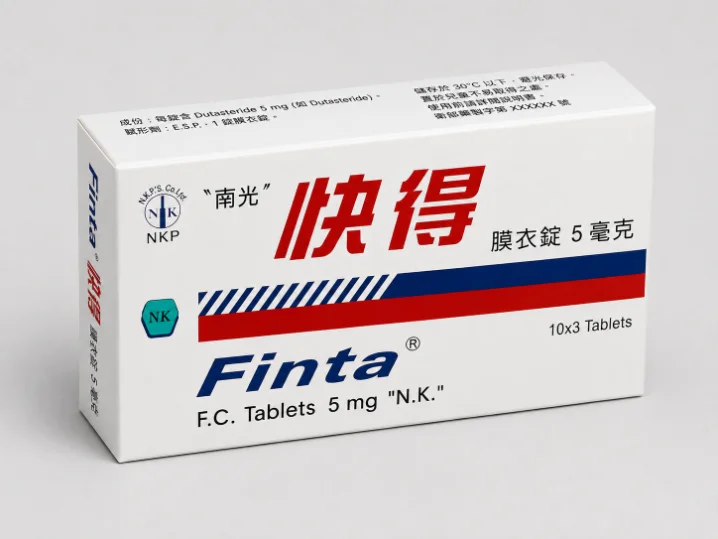
快得 (Taiwan generic)
White to pale yellow, round tablet
Off-label use (not an approved indication for this medicine). Please discuss it fully with your doctor first.
Oral dutasteride (0.5 mg)
Common brands (tap to see what each looks like)
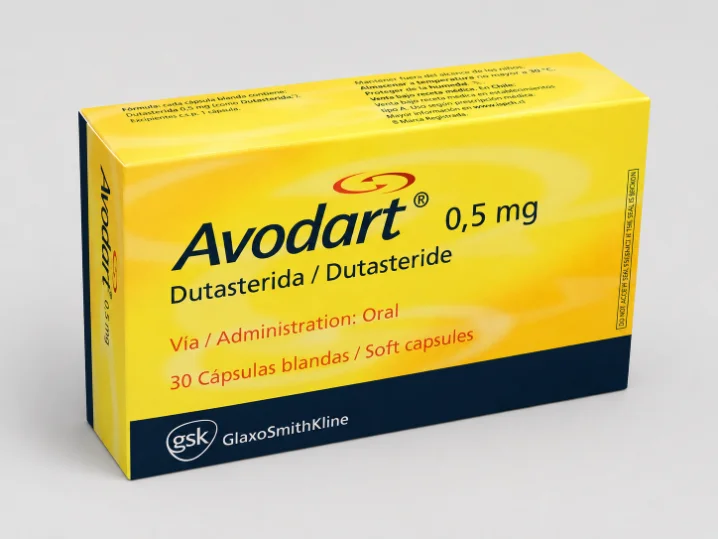
Avodart
Yellow to brown, oval soft capsule
Off-label use (not an approved indication for this medicine). Please discuss it fully with your doctor first.
Topical finasteride
Oral minoxidil
Common brands (tap to see what each looks like)
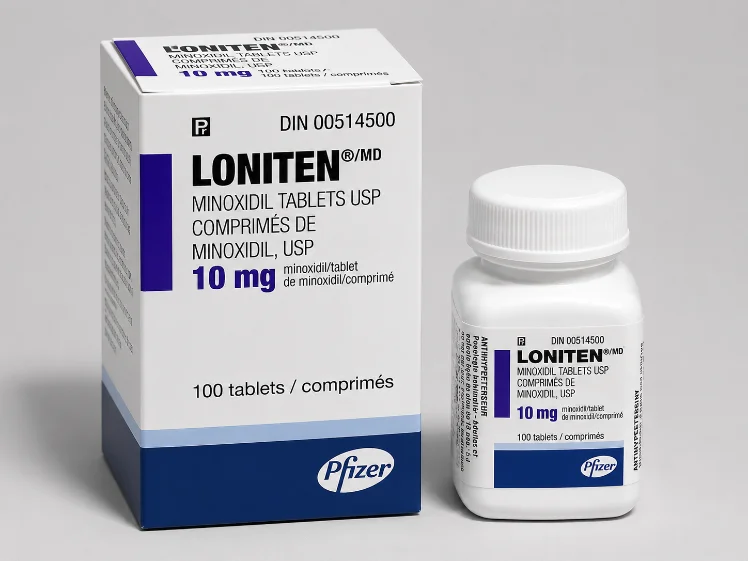
Loniten
Small, white, round tablet
Topical minoxidil (2% / 5%)
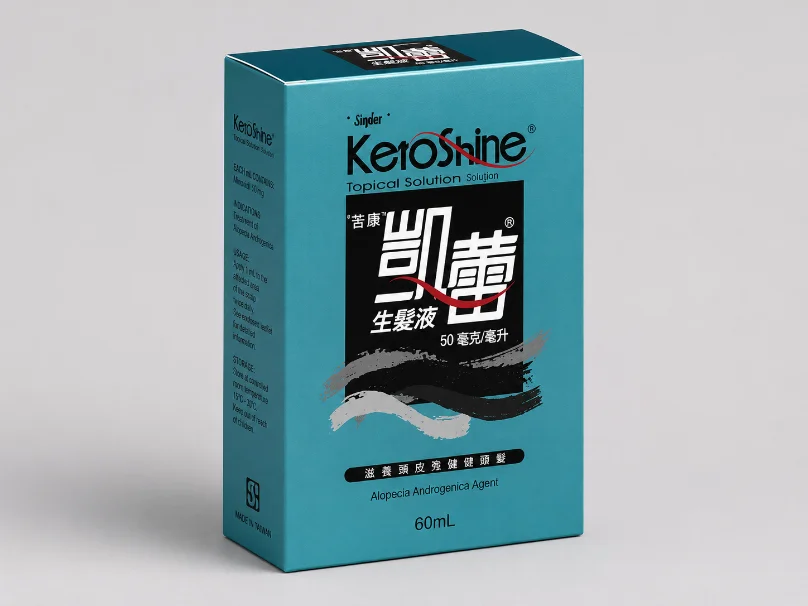
Many brands are sold, so not all can be shown here. Please check with your doctor or pharmacist what yours should look like.
Form: Hair-growth solution or foam
Nutritional supplement (洛克靈, sold in Taiwan)
Hair-growth cap (low-level red / near-infrared light)
Hair-growth laser (Er:YAG)